
Function as a Service (FaaS) Explained

Function as a service (FaaS), also known as “serverless” computing, is an option for deploying applications in the cloud.

It’s been around for almost a decade and has been available from the mainstream cloud providers for at least six years. For example, Amazon released AWS Lambdas in late 2014. Microsoft made Azure functions available in early 2016.

But, what exactly is serverless computing? When is it the right choice?  When you’re designing an application to use a serverless architecture, what do you need to consider?

Let’s take a look.

Functions Depicted with Scalyr colors signifying faas


What Is FaaS?

FaaS simplifies deploying applications to the cloud. With serverless computing, you install a piece of business logic, a “function,” on a cloud platform.

The platform executes the function on demand. So you can run backend code without provisioning or maintaining servers.

But that’s only part of the story.

The cloud platform makes the function available and manages resource allocation for you. If the system needs to accommodate 100 simultaneous requests, it allocates 100 (or more) copies of your service.

If demand drops to two concurrent requests, it destroys the unneeded ones. You pay for the resources your functions use, and only when your functions need them.

“Serverless” computing has servers, but they’re not your problem. The cloud provider manages them for you.

SaaS? PaaS? IaaS? Where Does This Fit in?

There are a lot of different XaaS acronyms floating around out there. What are the differences? Where does FaaS fit in?

  • Infrastructure as a Service (IaaS) gives you the building blocks for applications. It typically provides access to computers (virtual or on dedicated hardware), networks, and storage. AWS S3 and EC are two commonly used examples. IaaS offers you the most control, but you have to build your systems and networks from scratch.
  • Platform as a Service (PaaS) offers cloud components mainly for applications. It gives developers a framework for creating customized applications. Some prominent examples are AWS Elastic Beanstalk and Google App Engine. PaaS makes deploying applications easy, but at the cost of vendor-lock-in and often increased cost.
  • Software as a Service (SaaS) is complete applications delivered from the cloud, like Office365 and Scalyr.

FaaS is closer to PaaS than IaaS but with some critical differences.

Instead of deploying an entire application to one or more servers, with FaaS, you install functions, parts of an app. The functions are only loaded when needed and can be executed in parallel on-demand.

Let’s take a closer look at how this works and why it’s effective.

Why FaaS?

So we’ve already covered three of the main advantages of FaaS:

  • Managing servers is no longer your problem
  • The platform manages horizontal scaling for you
  • You only pay for what you use

By managing the servers for you, FaaS abstracts the server platform away from your application too. You can write your functions in almost any language. You can access other cloud resources like databases and caches.

If you conform to the platform’s defined interfaces, your service will work. This freedom doesn’t come for free, though. FaaS places constraints on functions, and it’s not always the best option.

Automatic Horizontal Scaling

The automatic scaling you get with serverless computing is a significant benefit. It saves you money and protects you from unexpected spikes in usage. As long as you pay your bill, your application remains available.

Without dynamic scaling, you have to size your system based on the most substantial level of utilization, not an average. This means paying for resources that spend most of their time doing nothing.

Even then, the sizing is an estimate based on past usage. What happens when demand exceeds that estimate?

Another option is to roll your own cloud scaling using technology like Docker. This solution still means incurring a great deal of overhead in both cloud resources and personnel.

Containers and orchestration provide you with dynamic scaling and excellent recovery capabilities, but you still need servers and skilled DevOps people. Even containers need security patches.

FaaS applications are simple to deploy and update. They are, as the name implies, functions.

You don’t need to enable extra systems or be a cloud expert. All you need to do is upload your compiled code and tell the platform how to provision it. You can focus on your application instead of worrying about cloud infrastructure.

Functions scale horizontally. Your service provider provisions new instances on-demand and shuts them down when they are no longer needed. Think about the power this gives you!

Instead of dividing functionality over one or more REST servers, you can decompose your application into discrete functions. FAAS almost makes REST services look like old-fashioned application servers!

When Does This Work Well?

So why isn’t everyone migrating their applications to serverless?

FaaS isn’t always the best option, or even possible, for some applications. There are design constraints. But first, let’s look at when it works well.

The name “Function as a Service” isn’t an accident or affectation.

Your service needs to operate like a mathematical function. Each invocation must be stateless; you can’t assume that information about one call to your service will be available in a subsequent request. Any state your application needs must be externalized to a database or filesystem.

This restriction makes perfect sense. FaaS provides scaling for you but without demanding any intimate application knowledge. It can only do this by assuming that it doesn’t have to manage any application state for you.

So if your functions don’t maintain state or solely rely on external resources for it, they’re a good fit for FaaS. RESTful applications are a good example. The functions externalize resource state while clients bear responsibility for maintaining their own.

An event-driven service that needs horizontal scaling can enjoy running as a function. FaaS platforms use the events to create instances of the functions and react based on the volume of requests.

RESTFul and other event-driven applications are a good fit, and so is work that runs on a schedule. Instead of paying for one or more servers that sit dormant most of the time, you can write the job as a function.

When Is FaaS a Bad Fit?

The limitation on application state isn’t the only constraint on serverless computing. There are a few more, and they may prevent your application from running as one or more functions.

Or, they might mean you need to rethink your design.

The platform loads functions on demand. They should start up quickly, usually in milliseconds.

Then the platform immediately gives them a request. When processing completes, it terminates them. The platform may reuse an instance with a “warm start” to save time, but the function cannot rely on this.

This is where the constraint on state comes from. But it also means that an application that performs a lot of initialization will not work well with FaaS.

functions have hard limits on execution time.

AWS limits Lambdas to 15 minutes of execution time. Azure limits its Functions to 10 minutes.

This is plenty of time for an API call, but it might not be for a scheduled job. Unfortunately, functions have hard limits on execution time.

FaaS might also be a bad fit if you’re concerned about vendor lock-in and can’t figure out how to code around it. If you’re going to have someone else run your code on their platform, you need to write to their API.

Depending on how you structure your code, you may be able to avoid lock-in. But if you do, serverless might not be the right solution. Or you might not care.

Decreased Cost and Increased Efficiency

Cloud vendors bill FaaS based on consumption. You pay for what you use after you use it. You can even control this by setting limits on usage if your application is amenable to that.

This is in stark contrast to provisioning servers in advance, based on the anticipated load, where you are always hoping that you pay for more than you need.

Not having to run servers also means less, or no, staff to maintain them. The cloud provider maintains everything in serverless architecture, eliminating the need for system administration.

Even if you can only offload part of your application to serverless, you can save on staff or allow them to focus on the critical parts of your mission.

What Are Some FaaS Best Practices?

There are a few simple rules you can follow to make deploying FaaS work for you.

  • Remember the limitations on application state. If you find yourself planning workarounds so that your functions can hold state, you’re using the wrong architecture.
  • FaaS is a powerful technology, and once you’ve seen it in action, you may want to use it everywhere. You can’t.
  • Make sure your functions perform one and only one action. Think in terms of a single request that yields a single response. Keep it simple.
  • Resist the urge to overcome the one-and-only-one operation rule by having one call another. One of the primary benefits of serverless architecture is isolation. Creating dependencies between them negates that advantage.
  • Finally, keep an eye on that load time. Again, keep it simple! Don’t use too many libraries or write a function that requires a lot of memory.


How Do I Start Using Faas?

Amazon launched AWS Lambda in 2014. Since then, it’s grown into one of their most important services. It’s the platform for Alexa Skills Development and a useful mechanism for accessing many of AWS’s monitoring features. Lambda has native support for Java, Go, PowerShell, Node.js, C#, Python, and Ruby code. You can get started with one of their tutorials here.

Microsoft launched Azure Functions a couple of years after Lambda, but it’s made up a lot of ground since then. You can code Functions in C#, JavaScript/Typescript, F#, Java, Powershell, PHP, and Python. Azure also has support for “Workflows,” which add a limited notion of state to services. You can follow links to different tutorials from this page.

The Google Cloud Platform has Cloud Functions. Google’s Functions support Javascript, Python, Ruby, Java, .NET, Go, and PHP. Functions support an event model that you can extend with plugins. Google’s getting started guide is here.

Cloudflare Serverless supports the creation of Javascript-based workers for offloading work from your web infrastructure and into Cloudflare, where it will run instances where they are needed. This is a compelling feature if your clients cover the globe.

If you don’t want to tie yourself to a specific cloud vendor, you can implement FaaS with Kubernetes and Knative. Kubernetes is an open-source orchestration tool for Docker. You can run Kubernetes on cloud architectures like AWS and GCP, or you can run it on-premises.

With Knative, you run FaaS on your Kubernetes cluster. This powerful combination provides you with horizontal scaling, powerful monitoring tools, and a very high level of fault tolerance.

What Are Some Examples of FaaS?

You may not realize it, but you’ve used serverless architectures.

Have you ever used Amazon’s Alexa? All of Alexa’s skills are implemented as AWS Lambdas. If you think about it, it makes perfect sense. Skills need to load quickly and don’t require any state. Amazon also needs to be able to scale them based on demand. Some skills, like news and weather, are used very heavily. Others mush less so,

Extract, Transform, Load (ETL) processes lend themselves to FaaS. Retrieving data, processing it, and storing the results in a database (or any other store) works well as a function that can be triggered remotely or set up on a schedule.

FaaS provides you with a way to process these jobs in parallel with multiple functions—as many as your store can handle—and then stop paying for the functions when they’re done.

faas

Does FaaS Work For You?

Serverless computing has a lot to offer. It provides an easy path to migrating or building new services in the cloud.

Without the overhead of managing servers and with the increased efficiency of paying for only what you need, you can focus on your business and your application, and your logs.

Scalyr integrates perfectly with FaaS, since it gives you a central store of your logs, with fast ingestion, embedded metrics, and an unparalleled query language.
READ MORE

Criminal Gang Impersonates Russian Government in Phishing Campaign

Researchers at IBM Security X-Force are tracking a financially motivated cybercriminal group called “Hive0117” that’s impersonating a Russian government agency to target users in Eastern Europe.

“The campaign masquerades as official communications from the Russian Government’s Federal Bailiffs Service, the Russian-language emails are addressed to users in Lithuania, Estonia, and Russia in the Telecommunications, Electronic and Industrial sectors,” the researchers write. “The activity predates and is not believed to be associated with the Russian-led invasion of Ukraine.”

The phishing emails contain a malicious zip file that will install the DarkWatchman remote access Trojan. The emails attempt to convince the user to download and open this file.

“The contents of the emails feature identical Russian-language text detailing several articles related to enforcement procedures associated with the Kuntsevsky District Court of Moscow, upheld by the ‘Bailiff of the Interdistrict Department of Bailiffs for the Execution of Decisions of the Tax Authorities,’” the researchers write. “The only variation observed by X-Force within the emails is in the name and ‘case number’ associated with the individual email and accompanying malicious ZIP archive file attachment.”

The researchers note that some of the emails were specifically sent to high-ranking employees at the targeted companies.

“X-Force discovered multiple emails that were sent in mid-February 2022 to individual users, including a state-owned communication company based in Lithuania, a prominent Industrial Enterprise in Estonia, and several electronic and telecommunication businesses located in Russia,” the researchers write. “In some cases, the emails were targeting company owners, as well as individuals in leadership positions associated with Dispatch Services and Sales. Targeted organizations could be of high value to criminal actors given the targets’ potential trusted access to a wide and distributed client base.”

READ MORE

New Phishing Attack Targets MetaMask Users for their Crypto Wallet Private Keys

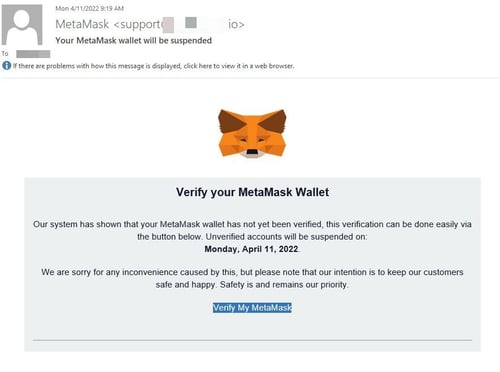
A new phishing campaign impersonates MetaMask, informs victims their cryptocurrency wallets aren’t “verified” and threatens suspension.

Cybercriminals will go wherever they a) perceive the money is and b) wherever they have expertise in the scam. In the case of the latest attack on MetaMask users identified by security researchers at Bitdefender Labs, the mastermind behind this attack certainly understands how MetaMask works.

In the scam, the potential victim user is sent an email impersonating MetaMask, asking for their wallet to be verified:

MetaMask scam

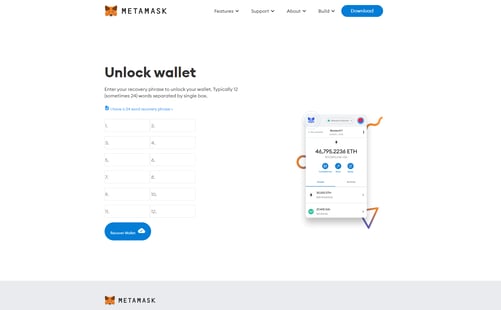
Those that click the “Verify My MetaMask” are taken to a phishing site made to look like MetaMask’s website. On the site, the victim is asked to provide their recovery phrase (a sequence of ten random words established when the wallet is setup that can be used to recover access to the wallet should the credentials be lost).

MetaMask Impersonation Scam

Once the recovery phrase is provided, it’s game over for the wallet owner, and funds are difficult to recover.

The key to the success of this campaign is found in the urgency it creates; the threat of suspending the wallet if it is not verified is enough to make unsuspecting recipients of this phishing email act accordingly and give up their most secret details about their MetaMask wallet.

This use of urgency is found in nearly every phishing scam – whether targeting individuals or users within an organization. And it’s only through having a vigilant mindset when receiving an email like the one above that will cause the recipient to pause and scrutinize the email to determine whether it’s legitimate or not before following the instructions found within. This vigilance is established in organizations through continual Security Awareness Training designed to not just teach users that scams are everywhere, but how they work, what role the user themselves plays in a phishing attack, and how they can stop the attack by simply paying attention.

READ MORE

Defending the Enterprise Against Digital Supply Chain Risk in 2022

Technology is an ever-changing landscape where we evolve and improve year over year much like the Moore’s Law theory with processor speeds. Cybersecurity, on the other hand, becomes more complicated and more diverse with the evolution of software and hardware vulnerabilities, which drives a larger and more complicated digital landscape for security professionals. According to Gartner, among the top seven trends in Cyber Security for 2022 is Digital Supply Chain Risk. Given the recent history of successful supply chain attacks, this should come as no surprise to CISOs and CIOs. The question is: how can you prepare your organization to effectively protect against a supply chain attack?

What Is A Supply Chain Attack?

Rather than attacking an organization directly, a software supply chain attack targets the vendors of apps and other code used by the organization. Typically, the bad actors will look to exploit some weakness in the vendor’s development cycle and attempt to inject malicious code into a signed and certified application.

By contaminating update servers or development tools, inserting code into executables, or simply replacing real packages with fake ones, adversaries can gain access to victims further along the supply chain.

A Brief History Of Supply Chain Attacks In The News

Here’s a quick breakdown of the most impactful supply chain attacks over the last decade or so.

RSA Security – 2011

  • Compromised RSA’s “seed warehouse” for SecurID tokens.
  • Allowing for the attacker to clone to break into other systems leveraging SecurID tokens.
  • Attack delivered via spearphish with attachment “2011 Recruitment plan.xls” from a HR partner org!
  • Used zero day Adobe Flash Player to drop a Poison Ivy RAT.

Target – 2013

  • A heating, ventilation, and air conditioning (HVAC) supplier allowed access into Target.
  • The hackers compromised Target’s server and placed the malware on POS devices across their entire store network.
  • Compromised over 40 million credit and debit cards.
  • 18.5 million in settlement claims and untold reputation damage. Even Target has estimated this has had over $200 million in impact.

CCleaner – March 2017

  • Hugely popular software (2BN total downloads by 2017) compromised to include a backdoor ‘ShadowPad’.
  • Piriform breached via stolen TeamViewer creds, then installed ShadowPad malware to infect software distribution systems.
  • Binaries were being legitimately signed!
  • Allowed the attacker to record keystrokes and included a password stealer.
  • 2.27M compromised downloads, with 1.65M communicated with CnC server.
  • 40 PCs targeted with 2nd stage infection.

ASUSTek Computer – 2019

  • ASUS Live Update Utility service delivered malware to 1000s of customers.
  • Impacted up to 500,000 computers.
  • Targeted 600 specific hardcoded MAC addresses.
  • Legitimate code signing certificate used.
  • Operation ShadowHammer had similarities to ShadowPad, group also linked to CCleaner attack.

SolarWinds – December 2020

  • SUNBURST malicious code deployed by SolarWinds Orion official updates.
  • Widely trusted software vendor with 300,000 customers.
  • Impacted some 18,000 customers.
  • Malware waits 12 days before executing and initiating to its C2.
  • 264 days from malware compilation, to detection in December.
  • High value targets including security vendor and US Gov.

Kaseya – July 2021

  • Kaseya VSA software used to deliver ransomware.
  • Compromised approx. 1500 customers.
  • Attackers leveraged two (known) vulnerabilities in the VSA software.
  • Financially motivated – $70M ransom.
  • Russia linked group REvil took credit leveraging their ransomware; also, behind June 2021’s JBS ransomware attack.

Based on these previous attacks, we can determine the following are the primary focus for threat actors:

  • Targeting insecure software for building systems or large-scale updating platforms.
  • Targeting custom in-house development or specialized code/firmware.
  • Using stolen certificates to sign apps, making themselves look like a trusted 3rd-party product or a product developed in house.
  • Exploiting vulnerable devices, from network gear to IoT and POS, allowing for the shipment and movement of pre-installed malware.

How To Protect Against Supply Chain Attacks?

As we’ve learned from the trends of supply chain attacks, we need to encourage strong security practices from our software vendors and developers, then prepare for those who are not meeting those standards.

For the organization looking to protect against supply chain attacks, there are a number of action points that should be implemented.

First of all, be sure to enforce strong code application integrity policies to allow only authorized apps to run. This can be accomplished by leveraging SSO Authorization Code Grant or leverage an Application Control platform for your organization.

Next, make sure that you leverage a strong Endpoint Detection and Response (EDR) solution that can automatically detect and remediate suspicious activities in real time. When looking into an EDR solution, make sure it’s meeting your company’s minimum criteria and view the MITRE ATT&CK Evaluations when comparing products. Some crucial questions to take into consideration are:

  • How does the EDR solution protect your assets? Does it require an Agent? Is it Agentless? If you don’t have an agent, what features are you missing leveraging an Agentless EDR solution?
  • What Devices or Operating Systems (OS) are not Covered by the EDR Security Solution? How many different types of agents/policies are needed to expand to these different OS’s?
  • Does this EDR Solution expand to Cloud Platforms?
  • Does this EDR software provide easy integrations with other systems?
  • How much automation does the EDR provide out of the box?
  • How long can I store data with this EDR solution? Most organizations need a minimum of two to three months of logs for audit purposes.
  • If your company has a merger and acquisition, how complicated would it be to combine your EDR solution with theirs?

Aside from ensuring you have the right endpoint detection and response solution to meet your business needs, consider using an open and flexible security platform that can maximize your visibility. An Extended Detection & Response (XDR) platform can offer flexibility, visibility and peace of mind knowing you have a single place to go in the event of a cyber security attack. XDR also offers better ROI and can make your company more cost efficient by finding trends and bad practices within your organization.

Of course, even with the right technology in place, it’s still vital to be prepared for data loss or denial of service with secure backups and regular redeployment testing. While ransomware attackers have evolved their extortion tactics to beyond mere denial of service, effective backups remain necessary due to the possibility of local disasters or just general hardware failure. You should follow a standard that meets the risk level you’re comfortable with, whether that is the 3-2-1 backup rule or 3-2-1-1-0 or 4-3-2. Stick with a plan and make sure you’re securing these backups to prevent tampering, then have a schedule or audit where you test these backups.

Drive a Cybersecurity-Centric Culture

Besides making sure your technology stack is up to scratch for a modern enterprise, there are other changes needed. It’s crucial to drive a Cybersecurity-Centric Culture in your company to make sure that your investment in technology reaches its full potential.

There has been plenty of good research into how to effectively implement a cybersecurity-first culture, but in essence it boils down to the following.

  • Empowering People—Cybersecurity culture empowers people with the sociological and psychological skills that are required to work with cybersecurity technology and processes.
  • Projecting cybersecurity meaning—Within the enterprise, the importance of the people, technology and processes of cybersecurity is understood. The consequences of ignoring cybersecurity’s technological and financial risk are addressed.
  • Establishing stakeholder partnership and collaboration of key players—A network of cybersecurity stakeholders is defined and managed. Stakeholders include employees, managers, government agencies, senior executives, boards of directors, technology providers, consulting providers, and education and training providers.
  • Providing an education and training road map—An appropriate education and training program that encompasses the people, technology and processes of cybersecurity is integrated and delivered.

Empower Security Hygiene for Developers

For the software vendors and developers needing to improve their security posture to prevent the opportunity of supply chain attacks, start considering the following options:

  • Maintain a secure infrastructure around update/build management.
    • Don’t delay on security patches for either OS/Software driven vulnerabilities.
    • Require mandatory integrity controls to ensure only trusted tools can run in your organization; investigate into implementing CISA Zero Trust Maturity Model.
    • Look into passwordless authentication and require Multi-Factor Authentication (MFA) for all admins.
  • If you haven’t already, build secure software updaters as part of your Secure Software Development Lifecycle (SSDLC).
    • Require SSL for update channels and implement certificate pinning.
    • Everything should be signed, including configuration files, scripts, XML Files, and packages.
    • Don’t allow your updater to accept generic input or commands, require digital signatures.
  • Develop an Incident Response (IR) plan for supply chain attacks, create a runbook and actually stress-test it with attack simulations.

Conclusion

Bad actors are always looking for an easy buck, with the least amount of resistance for the biggest opportunity, and supply chain attacks are still on the radar for these groups. The landscape is getting even more complicated with 9 out of 10 companies leveraging open-source software projects. Add to that the growing use of Internet of things (IoT) for cars and smart devices like appliances, door locks and thermostats, as well as the growth of IoT in healthcare and industrial/energy, and you have a never-ending expansion of the attack surface in almost every organization.

It is essential that organizations review their cybersecurity requirements, gain visibility into supply chain dependencies, and be prepared with modern tools and practices to help contain and prevent future supply chain attacks.

READ MORE

Community Associations Confront Social Engineering

It’s not just deep-pocketed corporations that prove attractive targets for social engineering. Any organization that holds information that can fetch a good price in the criminal marketplace will draw the attention of social engineers.

According to Risk & Insurance, a case in point may be found in community associations. They hold a great deal of personal data: names and addresses of their members, and often those members’ Social Security numbers, bank accounts, and credit card information. The value of these data in the criminal-to-criminal market is obvious.

Moreover, those data can all too often be poorly protected. Kevin Davis, president of Kevin Davis Insurance Services, told Risk & Insurance, “These groups are prime targets for cybercriminals due to their low-tech systems housing sensitive information…. Many do not have a risk assessment plan to identify system vulnerabilities, nor do they have a documented security-incident response plan. Once criminals get inside the community association system, they have easy access to social security numbers, banking information, email addresses, client information, anything that will create serious problems for the association.”

The article outlines five approaches criminals commonly use against community associations. Impersonation scams, whether by email or by phone, are often seen. “One of the most common types of social engineering scams in recent years is when fraudsters impersonate the U.S. Social Security Administration (SSA),” Davis said. A second risk is ransomware, usually installed when a worker is induced to click a malicious link. A third risk is posed by a lost or stolen device, since some associations overlook best practices in protecting such devices. Weak passwords, for example, are all too common. The fourth threat is business email compromise. And the fifth is a general risk shared by many businesses and other organizations: remote work increases exposure to compromise.

READ MORE

Netflix lost 200k subscribers in just 3 months Readies global crackdown on password sharing, considers ad-tier.

Netflix lost 200,000 subscribers in the first quarter of 2022 and is expecting another two million will walk away from the service before the end of June.

The shock disclosure – which was part of Netflix’s routine earnings call – wiped US$54 billion off the company’s market value in a single day with its price tumbling by 35 per cent from US$348 on Monday to US$226 by close of trading on Tuesday, local time.

“Our revenue growth has slowed considerably,” the company said in a letter to shareholders.

“Streaming is winning over linear [TV], as we predicted, and Netflix titles are very popular globally.

“However, our relatively high household penetration – when including the large number of households sharing accounts – combined with competition, is creating revenue growth headwinds.”

Netflix has forecast an increase in this downtrend and has braced shareholders for a further two million subscribers to leave the platform by the middle of the year.

“COVID clouded the picture by significantly increasing our growth in 2020, leading us to believe that most of our slowing growth in 2021 was due to the COVID pull forward,” Netflix said, chalking the negative subscription movement up to four factors.

First is the uptake of broadband-connected household TVs around the world, an uncontrollable factor that should bring more customers over time but which has slowed somewhat.

Then there is Netflix’s estimate that 100 million households share an account.

While the proportion of account sharing hasn’t changed much, the company said, it does limit the number of new customers that can be acquired.

As such, account sharing is something Netflix wants to either rein in or find a way to better monetise by charging people more if they share credentials with people outside their household.

“So if you’ve got a sister, let’s say, that’s living in a different city, you want to share Netflix with her, that’s great. We’re not trying to shut down that sharing,” Netflix chief product officer Gregory Peters said on the recent earnings call.

“But we’re going to ask you to pay a bit more to be able to share with her and so that she gets the benefit and the value of the service, but we also get the revenue associated with that viewing.”

Competition was the third factor because, as us consumers are constantly aware, there is now a wealth of different streaming platforms from major brands and well-established studios taking up a larger share of the on-demand video market.

Finally, ongoing macro-economic factors like inflation concerns, ongoing slow economic growth, and Russia’s invasion of Ukraine as causes for the subscriber slip.

When asked if Netflix would consider a cheaper subscription tier that incorporates advertising into the videos – a model in use by its competitors Hulu and Disney – the company’s co-founder and co-CEO Wilmot Hastings said Netflix was exploring that option.

“I don’t think we have a lot of doubt that it works, that all those companies have figured it out,” he said.

“It would be a plan layer. So if you want the ad-free option, you’ll be able to have that as a consumer.

“And if you would rather pay a lower price and you’re ad-tolerant, we’re going to cater to you also.”

Looking at a regional breakdown of Netflix’s membership numbers, only Asia Pacific saw growth in net paid membership from January to March 2022, adding 1,000,000 new subscribers.

But in North America, South America, and the large Europe, Middle East and Africa segment, memberships dropped considerably.

North America saw the biggest total drop in numbers with 636,000 people abandoning their monthly Netflix payment.

READ MORE

LinkedIn is the Most Impersonated Brand in Phishing Attacks

Social media companies, particularly LinkedIn, are now the most impersonated brands in phishing campaigns, researchers at Check Point have found.

“Social media networks have now overtaken shipping, retail and technology as the category most likely to be targeted by criminal groups,” the researchers write. “So far this year, LinkedIn has been related to more than half (52%) of all phishing-related attacks globally, marking the first time the social media network has reached the top of rankings. It represents a dramatic 44% uplift from the previous quarter, when LinkedIn was in fifth position and related to only 8% of phishing attempts. LinkedIn has now overtaken DHL as the most targeted brand, which has now fallen to second position and accounted for 14% of all phishing attempts during the quarter.”

Shipping companies are still in second place, with DHL and FedEx impersonation accounting for a significant portion of phishing attacks.

“Shipping is now the second most targeted category, with threat actors continuing to take advantage of the general rise in e-commerce by targeting consumers and shipping companies directly,” the researchers write. “DHL is second to LinkedIn, accounting for 14% of phishing attempts; FedEx has moved from seventh position to fifth, now accounting for 6% of all phishing attempts; and Maersk and AliExpress have entered the top ten list for the first time. Our report highlights one particular phishing strategy that used Maersk-branded emails to encourage the download of spoof transport documents, infecting workstations with malware.”

Attackers have also impersonated shipping giant Maersk with phishing emails that deliver the Agent Tesla malware.

“During the first quarter of 2022, we observed a malicious phishing email that used Maersk’s branding and was trying to download the Agent Tesla RAT (Remote Access Trojan) to the user’s machine,” the researchers write. “The email which was sent from a webmail address and spoofed to appear as if it was sent from ‘Maersk Notification (service@maersk[.]com)’, contained the subject, ‘Maersk : Verify Copy for Bill of Lading XXXXXXXXX ready for verification.’ The content asked to download an excel file ‘Transport-Document’, that would cause the system to be infected with Agent Tesla.”

READ MORE

TraderTraitor: When States do Social Engineering

North Korea’s Lazarus Group is using social engineering attacks to target users of cryptocurrency, according to a joint advisory from the US FBI, the Cybersecurity and Infrastructure Security Agency (CISA), and the US Treasury Department.

“The U.S. government has observed North Korean cyber actors targeting a variety of organizations in the blockchain technology and cryptocurrency industry, including cryptocurrency exchanges, decentralized finance (DeFi) protocols, play-to-earn cryptocurrency video games, cryptocurrency trading companies, venture capital funds investing in cryptocurrency, and individual holders of large amounts of cryptocurrency or valuable non-fungible tokens (NFTs),” the advisory says. “The activity described in this advisory involves social engineering of victims using a variety of communication platforms to encourage individuals to download trojanized cryptocurrency applications on Windows or macOS operating systems. The cyber actors then use the applications to gain access to the victim’s computer, propagate malware across the victim’s network environment, and steal private keys or exploit other security gaps. These activities enable additional follow-on activities that initiate fraudulent blockchain transactions.”

The threat actor is using spear phishing attacks to trick users into downloading malicious cryptocurrency apps.

“Intrusions begin with a large number of spear phishing messages sent to employees of cryptocurrency companies—often working in system administration or software development/IT operations (DevOps)—on a variety of communication platforms,” the advisory says. “The messages often mimic a recruitment effort and offer high-paying jobs to entice the recipients to download malware-laced cryptocurrency applications, which the U.S. government refers to as ‘TraderTraitor.’ The term TraderTraitor describes a series of malicious applications written using cross-platform JavaScript code with the Node.js runtime environment using the Electron framework. The malicious applications are derived from a variety of open-source projects and purport to be cryptocurrency trading or price prediction tools. TraderTraitor campaigns feature websites with modern design advertising the alleged features of the applications.”

North Korean threat actors are well-known for conducting financially motivated operations for their heavily sanctioned government. New-school security awareness training can teach your employees how to avoid falling for social engineering attacks.

READ MORE

Gig economy workers exploited by delivery giants Inquiry urges NSW government to offer more protections.

The NSW government needs to do more to protect gig economy workers from exploitation if the state is to continue taking advantage of ride share and delivery services, a parliamentary inquiry has found.

Handing down its first report, a NSW committee on the impacts of technology on the future of work has recommended the government build in greater legislative protections for gig economy workers and should require platforms to be more transparent about their workers’ payments.

The committee has now published 22 recommendations following two years’ worth of hearings in which it learned how the ‘independent contractors’ hired by the likes of Uber, Lyft, and Menulog are treated.

Committee Chair Daniel Mookhey said the lack of minimum wages, paid leave, and poor safety standards have been a major concern for the inquiry.

“The cyclist who delivers our Friday night takeaway receives next to none of the conditions long considered fair and decent across Australia,” he said.

“The job itself also puts workers in very real danger of injury, abuse and harassment.

“From extensive evidence over eight hearings to date, the committee has concluded that current laws perpetuate the overwhelming power imbalance between lone ‘contractors’ and multinational platform companies, rather than mitigating it.”

Gig economy workers are typically classified as ‘independent contractors’, not employees, allowing the companies that pay them to forego penalty rates, leave arrangements, and other benefits associated with being an employee.

For the likes of Uber, Lyft, and Amazon among others, ‘independent contractors’ have opened space for them operate lean, scalable businesses that can tap into casual workforces in markets around the world.

Likewise, fast food chains and restaurants that didn’t run their own delivery services could latch onto platforms and send their products to customers’ homes.

True cost of delivery

The committee heard of further economic benefits from the gig economy’s freedom in NSW such as job creation, a lower barrier of entry for work, and the ability for full- or part-time workers to earn supplementary income.

For workers – the platforms profess – one major benefit of gig economy work is flexibility of hours, something Amazon alludes to with the name of its ‘last-mile’ delivery platform Amazon Flex which must now pay its NSW gig economy drivers a minimum hourly rate.

But the flipside of this highly casualised work, as noted by Mookhey, is a severe lack of income protection, convoluted dispute resolution systems, and difficult working conditions that led to at least five deaths in Australia in late 2020.

“Inquiry participants advised the committee that a primary way that rideshare and food delivery platforms exert a high level of control over their workers is through their models of algorithmic management,” the inquiry’s first report said.

“This is because these platforms’ algorithms determine the allocation, remuneration, chastisement and even the termination of labour.”

Workers said they felt pushed by the algorithms to deliver food faster and are “encouraged to take health and safety risks to support themselves and their families”.

When workers are injured or killed at work, platforms tend to hide behind the ‘independent contractor’ status of their workers to avoid paying comensation.

In the US, the classification of workers as ‘independent contractors’ has led to recent stories about workers’ families still having to pay for funerals after their loved ones were murdered on the job.

Possible protections for gig economy workers recommended by the committee include legislative changes to provide food delivery and rideshare drivers with the same protections as independent transport workers.

The government has also been recommended to establish a “system of collective bargaining” for gig economy workers.

Temporary residents, students, and people who speak a second language at home are all more likely to be gig economy workers, which is most common among young males aged 18-34.

READ MORE

Headphone and air purifier combo, anyone? Would be more impressive if they could filter COVID-19.

Its early-April announcement had some crying ‘April Fool’ and pulling out the Bane memes, but Dyson’s space-age Zone air filter was quickly confirmed as a very real addition to a growing family of wearable air filters that have fans intrigued and experts concerned.

Marketed as ‘air-purifying headphones’, the Zone kills two birds with one stone by bundling Dyson’s first-ever audio headphones – a hi-fidelity, noise-cancelling design – with an unusual crossbar that encircles the front of the face.

Whether or not the unit is playing audio, its built-in filter purifies ambient air and blows the filtered stream directly across the wearer’s nose and mouth – providing a bubble of clean air that works as an alternative to conventional filtration masks.

The speed of airflow can be adjusted to, for example, provide more air when walking briskly or running.

“We’ve spent a lot of time developing purification systems to go in people’s homes, and we want to provide that same benefit for someone when they’re on the tube train commuting,” Dyson explained.

Taking the Zone from drawing board to working product took Dyson’s engineers six years of research and 500 prototypes, as they worked to miniaturise the drum-sized filters used in the company’s room air purifiers to a size where they could be built into the headphone speakers.

Thousands of filters were tried before the company settled on a design built around electrostatic media, which attracts the dust particles from the air rather than relying exclusively on pushing massive volumes of air through the units.

Dyson markets the technology as being intended for polluted city environments, where pervasive clouds of smoke and haze compromise air quality and make breathing difficult –potentially causing breathing difficulties and asthma attacks in many people.

With around 10.7 per cent of Australians suffering from asthma, the promise of portable filtered air may rapidly help shape the target market for the Zone – which will be released later this year into a global market where competitors have already tried to cash in on widespread awareness of air quality caused by the COVID-19 pandemic.

LG, for its part, last year released an air-purifying mask with a more conventional mask-like shape that snugly covers the mouth and nose, with a mid-year update adding built-in microphone and speakers to ampilfy the wearer’s voice after revelations the unit’s design was an effective muffle.

Razer has also released a portable air filter, with its Zephyr offering colourful lights and twin filters that looks more like the respirators an automotive spray painter might use.

Air Ring has offered yet another design, hiding the filter behind the neck and delivering clean air across a face-covering visor.

Throw in an array of wearable air purifier necklaces, and the options for portable air filtration are only continuing to expand.

But is it COVID safe?

Although more than two years of pandemic have normalised the wearing of face coverings, Dyson and its rivals are pushing the concept into new territory – and potential buyers must be aware that they are not making any claims that the units offer effective protection against COVID-19.

Air Ring, for its part, integrates N95 HEPA filters and a virucidal UV-C light, while Razer is quick to point out that the Zephyr “is not a N95 mask/respirator” despite claiming that it filters 99 per cent of bacteria from the air.

Asked whether the Zone’s FFFP2 filter would protect against COVID-19 particles, a Dyson representative told a Slate reporter that the visor “acts as a physical barrier against forward projection”.

Yet masks work by surrounding the mouth and nose with a filter – meaning that the Zone’s open design won’t stop an infected person spreading COVID.

One expert told Slate it was “irresponsible” to wear something that would actually accelerate exhaled COVID particles, speeding their spread into the surrounding air.

Others weren’t as concerned, noting the unit’s low-powered fan and the fact that it is most likely to be worn outside where the risk of transmitting the COVID-19 virus is lower.

Just how effective the device is, or isn’t, as a mask replacement won’t be known until it’s released later this year – but its potential value for urban asthma sufferers could rapidly change it from a design oddity into a lifesaver.

READ MORE