
Wanting to Stream the Italian Grand Prix This Weekend? It Might Be a Scam.

With so many fans worldwide wanting to watch the race online, cybercriminals have stepped up to meet the demand with fraudulent websites intent on stealing credit card details.

So you want to catch some or all of the Formula One race this weekend and do a search on the web for “Italian Grand Prix Streaming”. U.S. residents can find it on NBC’s sports website, while others can find plenty of articles talking about websites streaming for free.

But be careful!

Security vendor Kaspersky analyzed a number of sites claiming to offer “free” streaming, only to be asked to pay a small fee of $1 USD. While it seems inexpensive enough, it’s not the $1 the site owners want… it’s your credit card details. In other instances, phishing websites are setup to steal online credentials.

No matter the particular scam, cybercriminals are keen to take advantage of any heightened sense of need (in this case, to watch something you can’t easily do for free) as the hook for providing scammers with valuable details they can use or sell.

These kinds of scams are generally targeting individuals rather than corporations, but it’s just as easy for cybercriminals to target those wanting to watch a sporting event that occurs during business hours. And, instead of stealing credit card data, they use a simple “install our streaming viewer app” which turns out to be malware.

Keep your employees vigilant against such scams – whether they are at home or work – through continual Security Awareness Training, educating them on current scams, methods, techniques, and themes so phishing attacks that occur via email or the web can be easily spotted before it’s too late.
READ MORE

A Look at Phishing Keywords

Researchers at Expel offer a useful list of the top keywords used in phishing emails. First on the list is the word “invoice,” which is a general term that will be relevant to most organizations.

“Generic business terminology doesn’t immediately stand out as suspicious and maximizes relevance to the most potential recipients by blending in with legitimate emails, which presents challenges for security technology,” the researchers write. “Most people are also inclined to respond promptly to communications from co-workers, vendors or clients if they believe action is required, like returning an invoice.”

The word “new” is another potential red flag, since it will grab a user’s attention.

“‘New’ is commonly used in legitimate communications and notifications, and aims to raise the recipient’s interest,” Expel says. “People are drawn to new things in their inbox, wanting to make sure they don’t miss something important.”

Another common word used in phishing emails is “required,” which preys on a user’s sense of urgency.

“Keywords that promote action or a sense of urgency are favorites among attackers because they prompt people to click without taking as much time to think,” the researchers write. “‘Required’ also targets employees’ sense of responsibility to urge them to quickly take action.”

Expel notes that multifactor authentication (MFA) is an extremely important layer of defense against phishing attacks. While MFA isn’t foolproof, it makes it much more difficult for an attacker to breach an account even if they have the account’s credentials. The researchers add that employee education is another important layer of defense.

“Another important thing orgs can do to prevent successful phishing campaigns is to develop comprehensive phishing education programs,” Expel says. “Orgs should stay up-to-date on the latest phishing trends to update their policies and educate employees when new tactics are at play. Beyond training sessions, regularly test employees with mock phishing emails (and provide feedback on what in the email was suspicious) so they continue to learn, hone their detection skills, and know how to report suspicious emails in their inbox.”

New-school security awareness training can teach your employees to follow security best practices and enable them to recognize red flags associated with social engineering attacks.

READ MORE

The Number of Daily Ransomware Attacks Increase Nearly 1000% in 2021

New analysis of cyberattack data by security vendor Fortinet sheds light on not only how much ransomware is really being experienced, but who’s being attacked the most.

Just when I think I’ve seen it all, yet another stat from a new report shocks me. This time it comes from Fortinet’s FortiGuard Labs 1H 2021 Global Threat Landscape Report and revolves around the currently-observed state of ransomware. According to the report, ransomware is increasingly being felt by more and more organizations:

  • The weekly average number of ransomware attacks detected in June of 2021 was over 149,000. A year prior, it was only 14,000 – making an increase of 966%
  • Over one-third of businesses in the Automotive, MSSP, Government, and Telecommunications industries and one-quarter nearly all other sectors experienced ransomware attacks
  • The report noted that “the key takeaway is that ransomware is a clear and present danger regardless of industry or size.”

This data not only corroborates previously observed increases this year in the number of ransomware attacks, but helps to substantiate the kinds of organizations (the Fortinet report list over 20 industry verticals) that are consistently being targeted and – therefore – should be proactively putting protective measures in place.

This should include Security Awareness Training to enable users to stop email-based attacks that successfully make it past a layered set of security solutions designed to stop phishing, social engineering, and malware in its tracks.

READ MORE

Email-Based Cyberattacks Double Between January and June

Over 2.9 Billion email-based threats were detected in the first half of 2021. Business Email Compromise, obfuscation, and living off the land reigned, according to new data from Zix.

We’ve seen massive spikes before in the number of ransomware and other cyber attacks – usually when comparing a previous year to the current one. But rarely do we see a significant increase within just six months. According to the Global Threat Report: Mid-Year 2021 from Zix and AppRiver that’s exactly the case, with about 300,000 attacks in January of this year and over 600,000 in June.

The report provides several examples of attack trends observed by security researchers at Zix, including:

  • Increases in security solution obfuscation using Captcha and creatively encoding malicious attachments
  • The targeting of those looking for new jobs as workers return to the workplace
  • Living off the land using cloud resources, with Google APIs leading the way
  • Lots of Business Email Compromise
  • Use of many forms of banking trojans to steal banking and browser data

While most of the attack examples have equivalents here on our blog, this report does bring to light the increases in attack numbers and creativity you should expect to continue. The obfuscation is a particular focus for threat actors working to avoid detection by security solutions. Should they be successful, the last layer of defense is a well-prepared and vigilant user who, through continual Security Awareness Training, is always on the lookout for suspicious email content that may be the launching point for the next cyberattack.

READ MORE

Large Phishing Campaign Abuses Open Redirects

Researchers at Microsoft have observed a widespread phishing campaign that’s abusing open redirectors to fool users into visiting credential-harvesting pages. Open redirects are often used for legitimate purposes, such as tracking click rates. However, they can also be abused to disguise a link to a phishing page.

“The use of open redirects in email communications is common among organizations for various reasons,” the researchers write. “For example, sales and marketing campaigns use this feature to lead customers to a desired landing web page and track click rates and other metrics. However, attackers could abuse open redirects to link to a URL in a trusted domain and embed the eventual final malicious URL as a parameter. Such abuse may prevent users and security solutions from quickly recognizing possible malicious intent.”

Microsoft explains that this tactic can fool both users and technology, since the URL itself appears legitimate.

“[U]sers trained to hover on links and inspect for malicious artifacts in emails may still see a domain they trust and thus click it,” Microsoft says. “Likewise, traditional email gateway solutions may inadvertently allow emails from this campaign to pass through because their settings have been trained to recognize the primary URL without necessarily checking the malicious parameters hiding in plain sight.”

The researchers also note that this campaign makes use of hundreds of unique domains.

“This phishing campaign is also notable for its use of a wide variety of domains for its sender infrastructure—another attempt to evade detection,” the researchers write. “These include free email domains from numerous country code top-level domains (ccTLDs), compromised legitimate domains, and attacker-owned domain generated algorithm (DGA) domains. As of this writing, we have observed at least 350 unique phishing domains used for this campaign. This not only shows the scale with which this attack is being conducted, but it also demonstrates how much the attackers are investing in it, indicating potentially significant payoffs.”

New-school security awareness training can enable your employees to recognize red flags associated with social engineering attacks.

READ MORE

Cryptominers are Tricked out of Cryptocurrency Using Phishing Scams Involving the Purchase of Mining Equipment

The leveraging of Google Docs, a spoofed website, a realistic-feeling buying process, and asking for payment in cryptocurrency is all it takes to separate victims from thousands of dollars.

Despite news stories around phishing attacks resulting in stealing computer processing time for cryptomining, there are legitimate businesses out there that mine cryptocurrency to make money; it’s a simple business really – purchase needed hardware and use it to mine specific cryptocurrency that yields a positive return.

The one piece of hardware that’s most needed is the high-end video card; it’s internal processor is used to perform the calculations that represent the actual “mining”. Cryptomining is so widespread as a money-making operation that such video cards are hard to come by, driving up prices and lowering availability of inventory.

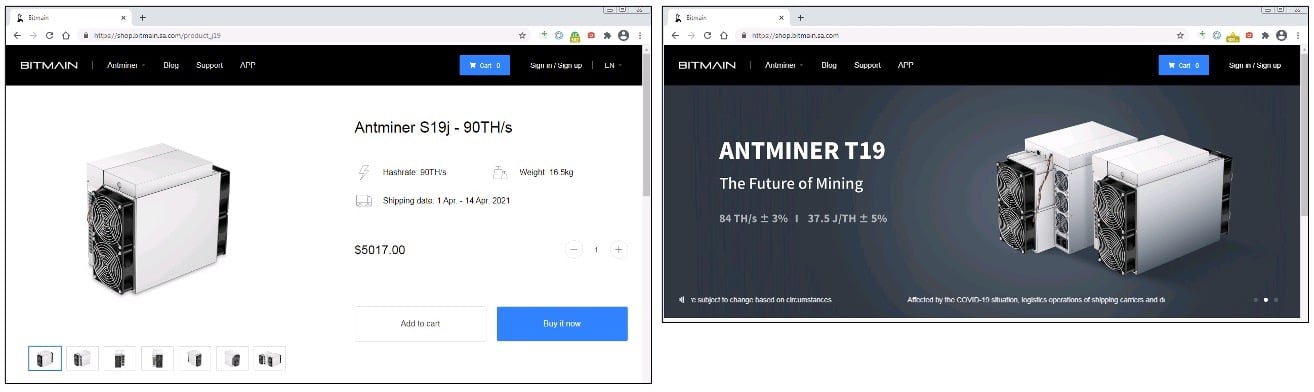
Security researchers at Kaspersky have identified a new scam that targets those involved with cryptomining. Using Google Docs to tag and notify a potential victim, scammers impersonate a legitimate mining hardware vendor, Bitmain.

7-30-21 Image

Bitmain’s website (left) and the impersonated site (right)

Source: Kaspersky

This scam uses a well built and functional spoofed website made to look like the real Bitmain site – including shopping cart, checkout process, etc. Because of the convincing nature of the site, scammers trick victims into purchasing hardware that doesn’t exist (and, in real life, it’s not available anywhere due to demand). The kicker to the transaction is victims are only able to pay for the fake hardware using cryptocurrency, with the cybercriminals providing cryptowallet details and a warning that the transaction must be completed within two hours or it will be cancelled.

Once the transaction is complete, the digital currency is gone, the users “account” on the faux Bitmain page is deactivated, and the scam is complete.

READ MORE

Cybercriminals Can Post Jobs on LinkedIn Posing as Any Employer They Want

Lax verification around what company is offering a given job on LinkedIn allows attackers to create bogus job postings for malicious purposes.

It appears that despite LinkedIn being potentially used as medium by cybercriminals to connect with victims, the ability exists today for a threat actor to impersonate being part of a legitimate company when posting a job.

Scams using job postings are one of the most powerful social engineering tactics used today – using a well-established site like LinkedIn to begin with and completely putting aside email-based phishing, matched with the desire of the potential candidate to follow whatever process is necessary to get that cool job at that great company with the awesome pay adds up to be a perfect cyber-storm.

I wrote about such attacks back in 2019, where a developer at a bank was looking for a new job and was tricked into installing a RAT under the premise it was a program designed to allow him to fill out an application. It appears that LinkedIn still has no means for verifying that the poster is from the company they say they are.

According to Bleeping Computer, security researchers were recently able to walk through the posting process without needing to validate the company they purported to work for. This is a huge advantage for the threat actor. Think about it – if I want to target a specific industry or company, post a dev job as a competing company in that same sector. Simple, elegant, and likely effective social engineering – all thanks to LinkedIn.

This kind of attack is one of the slickest as the victim feels completely like they are initiating the connection (as opposed to a phishing email that shows up in your Inbox) and is emotionally invested in following the process through to completion.

Falling for social engineering is one of the main reasons organizations need their users to enroll in continual Security Awareness Training – it’s not just within email that social engineering tactics are found; and this latest finding on LinkedIn affirms that notion.

READ MORE

U.K. Organizations See Double the Number of Ransomware Attacks in the First Half of 2021

New analysis of ransomware incidents reported to the UK’s Information Commissioner’s Office (ICO) in the first half of 2021 show a massive rise when compared to 2020.

Utilizing incident data reported to the ICO, British cyber security organization CybSafe has determined that 22% of all cyber incidents in the first six months of 2021 were attributed to ransomware attacks. This is double the 11% found in the first half of 2020.

This doubling of the number of reported attacks is troubling, but not surprising, as 35% of all U.K. businesses experience ransomware attacks (with the global average being 37%), according to Sophos’ State of Ransomware 2021 report. Additionally, 63% of U.K. businesses affected by ransomware reported their organizations’ brand was negatively impacted, according to CyberReason’s Ransomware: The True Cost To Business report, making ransomware a legitimate threat to business longevity in the U.K.

CybSafe’s analysis found that phishing was the primary cause of all cyber breaches reported to the ICO in the first half of this year, making up 40% of all successful attacks. Phishing continues to be a thorn in cybersecurity’s side, with some percentage of attacks finding their way past security solutions and into the Inbox where an unsuspecting user is fooled into clicking on malicious links and attachments.

It’s only through continual Security Awareness Training that users will elevate their state of vigilance, always being on the lookout for malicious content and reducing whatever threat surface remains by the time an attack reaches the Inbox.

READ MORE

A Look at a Ransomware Affiliate

The US Federal Bureau of Investigation (FBI) has issued an advisory describing a ransomware affiliate that calls itself “OnePercent Group,” the Record reports. The Record notes that the OnePercent Group is an affiliate of the REvil, Maze, and Egregor ransomware gangs. The threat actor gains initial access via phishing emails.

“OnePercent Group actors gain unauthorized access to victim networks through phishing emails with a malicious zip file attachment,” the FBI says. “The zip file includes a Microsoft Word or Excel document that contains malicious macros that allow the actors to subsequently infect the victim’s system with the banking Trojan IcedID. The actors use IcedID to install and execute the software Cobalt Strike on the victim’s network to move laterally to other systems within the environment through PowerShell remoting. The actors use rclone for data exfiltration from the victim’s network. The actors have been observed within the victim’s network for approximately one month prior to deployment of the ransomware.”

The FBI says the gang exfiltrates the victim’s data before encrypting it, then holds the stolen data for ransom.

“Once the ransomware is successfully deployed, the victim will start to receive phone calls through spoofed phone numbers with ransom demands and are provided a ProtonMail email address for further communication,” the Bureau says. “The actors will persistently demand to speak with a victim company’s designated negotiator or otherwise threaten to publish the stolen data. When a victim company does not respond, the actors send subsequent threats to publish the victim company’s stolen data via the same ProtonMail email address.”

The Bureau offers the following technical controls for organizations, but unfortunately forgot one of the most important ones when bad actors come in with phishing attacks: train those users with frequent simulated phishing attacks.

  • Back-up critical data offline.
  • Ensure administrators are not using ‘Admin Approval’ mode.
  • Implement Microsoft LAPS, if possible.
  • Ensure copies of critical data are in the cloud or on an external hard drive or storage device. This information should not be accessible from the compromised network.
  • Secure your back-ups and ensure data is not accessible for modification or deletion from the system where the original data resides.
  • Keep computers, devices, and applications patched and up-to-date.
  • Consider adding an email banner to emails received from outside your organization.
  • Disable unused remote access/Remote Desktop Protocol (RDP) ports and monitor remote access/RDP logs.
  • Audit user accounts with administrative privileges and configure access controls with least privilege in mind.
  • Implement network segmentation.
  • Use multi-factor authentication with strong passphrases.

New-school security awareness training can give your organization an essential layer of defense by teaching your employees to recognize phishing and other social engineering attacks.

READ MORE

Nigerian Threat Actors Solicit Victim Organization Employees to Deploy Demon Ransomware

The use of employees as insider accomplices potentially changes how social engineering is being used in exchange for a direct request for internal assistance.

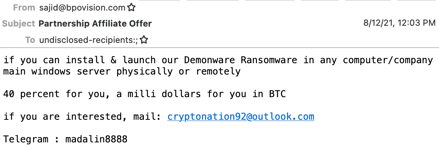
Security researchers at Abnormal Security have identified a recent set of emails soliciting employees of a would-be victim organization to participate in helping the threat actors by installing DemonWare/Black Kingdom ransomware within the organization.

The emails are simple in nature and contain no malicious links or attachments – something the threat actors hope will allow their request to get past security solutions.

demonware-initial-email

Source: Abnormal Security

The researchers at Abnormal Security decided to engage the threat actors to better understand how the infection would take place. A link to an executable file was provided via file sharing sites WeTransfer or Mega.nz. It’s also interesting to note that the $1M purse offered in the initial email was dropped down (during Abnormal Security engaging of the threat actor) to an offer of only $120K.

What’s most interesting is that Abnormal Security was able to get the threat actor to tell them his source of contacts: CEO and CFO emails from LinkedIn. So, even this lone threat actor is doing proper diligence using whatever means they can to target individuals within an organization.

While it’s evident this type of attack doesn’t fall within the realm of phishing, it could have gone awry in more ways than one. In this specific instance, the attacker legitimately wanted the insider to do all the work. But it’s also conceivable that social engineering could have been used to compromise credentials along the way. So it’s still important to include Security Awareness Training of even your highest C-level executives to ensure they don’t fall prey to scams.

READ MORE