Three Tips to Stay Safe on the Road and the Information Superhighway

You surf the world wide web, you scroll through social media feeds, read articles, shop online, and respond to email through the incredible invention of the internet. We’re all driving on the internet superhighway, but are we aware of what it means to be safe when we’re online? You know when driving in a car, you need to wear your seatbelts. You need to signal when changing lanes (well, some people do), and at a stop sign, make sure the car comes to a “full and complete” stop before waiting two seconds and proceeding forward if there is no other oncoming traffic.

People driving on the road find shortcuts or easier ways to evade some of the road’s safety rules. You might not always signal when turning or changing lanes, and I’ve seen many people who roll through stop signs, where they slow down, and if traffic is not coming, they make the turn. While these aren’t dangerous, people get comfortable with unsafe driving habits, which is very similar to unsafe internet surfing habits.

1. Double Check Links and Attachments Before Clicking
When you’re driving and the need arises to change lanes or turn onto another road, you have a flashing orange light on either side of the car to signal to other drivers your desire to change position. Like signaling a lane change or turning, users want to check any links or attachments they receive in their email. The email will not be malicious most of the time, like not signaling will not result in an accident. However, like not signaling, you run the risk the email is not malicious and could lead to a cybercriminal gaining access to your computer, the organization’s network, or worse, leading to data theft and damage to the brand.

Cybercriminals will send phishing or socially engineered emails to thousands of email accounts with a message that may be too good to be true, like winning money or striking curiosity with an attached file containing information the user needs to see. The cybercriminal’s expectation is not for everyone, but to get several people to open the email and click the link.  When you receive emails, it’s essential to be aware of proper thought processes, like “am I expecting this email?” or “do I know the sender?” or “why do I need to click the link?” Stopping and making sure the lane is clear or stopping to ensure the link is safe will provide a safer experience for you when surfing online.

2. Make Sure That Clickbait Isn’t Malicious
Coming to a “full and complete” stop in the car allows you to take a moment and check for oncoming traffic before proceeding into the intersection or making a turn. This action is a moment to stop and verify traffic. When surfing the web, you will come across links, advertisements or memes, which are humorous images with a saying that spreads rapidly online. All of these encourage you to click and follow the story — otherwise known as clickbait. These clickbait links help marketing companies track clicks of users interested in seeing the material. However, these advertisements may come from other third-party sources, which may not be vetted by the marketing service and can expose you to malicious code loading onto your device.

This code can allow cybercriminals to steal personally identifiable information, credit card numbers and other sensitive information. To guarantee a safer internet experience, when you sees those “too good to be true” or enticing messages about a celebrity’s latest escapade, you may want to ignore it, or if it’s really of interest, do an additional Google search to make sure that it’s valid. This step provides the chance to get a reputable link and site to read about the story further and avoid the unnecessary opportunity to have malware installed on your system.

3. Be Aware of Webcam Security Issues
Putting on your seatbelt in the car is necessary to protect yourself while driving. In the unfortunate event that you have a fender bender or another type of car accident, it reduces the risk of being thrown into the windshield or possibly smashing your head into the steering wheel. The seatbelt is designed to protect you while you’re driving, and a webcam cover can protect you from hackers watching you online. You’re online all the time with your laptops, smartphones and tablets. Most times, you may not be aware or forget that you have a webcam staring back at you. These webcams are a target of predators when they gain access to someone’s laptop.

Most cybercriminals go after Windows machines with webcams because they are easier to infect with malware, and most people do not cover their webcams. Cybercriminals are sophisticated to access the laptop and disable the LED light from turning on when they activate the camera. It’s critical to either put a piece of tape over the lens or get a webcam cover, as they are inexpensive to buy online. Like the seatbelt to protect you while you’re driving, having a webcam cover can protect you from someone capturing you when they’re in front of a computer.

Think Before You Click!

Whenever you’re online, you assume a risk that you could experience a data breach or hack by cybercriminals. This risk is similar to driving on the road, and we’re alert to other drivers to avoid a car accident and suffer the potential increased costs of our driver’s insurance. Unless you’re a large organization, you can get cyber insurance, but not for individuals. You have to implement your risk measures to protect yourself online on an individual level. Whether that’s checking email links to avoid a phishing attack, verifying clickbait articles that seem too good to be true or even putting tape over your webcam, these measures can provide you with an overall safer internet experience.

READ MORE

Every Employee is Part of Your Security

Employees are an essential component of an organization’s security defenses, according to Nico Popp, Chief Product Officer at Forcepoint. On the CyberWire’s Hacking Humans podcast, Popp explained that humans generally want to do the right thing and can help prevent cyberattacks that can’t be stopped by technical safeguards. Popp pointed to the way financial institutions have their customers verify potentially suspicious transactions as an example of this.

“I always use the example of credit card companies,” he said. “They have been brilliant. You know, they have huge fraud issues. And what have they done? They basically involve us in the process of solving, right? They don’t always block your credit card. They may block you, but they may ask you, you know what? We’ve seen that transaction. It looks suspicious to us. Is that really you trying to complete this thing? And it’s working, right? Can you imagine, they are using all these consumers to solve the fraud problem? And, of course, we care. So we participate.”

Popp concluded that organizations need to shift the way they think about how employees fit into their security posture.

“So, taking that concept of putting the human in the middle and saying, look, you’re part of the solution,” Popp said. “We’re going to engage you. It’s not just about monitoring you, spying on you. Quite the opposite. We’re trying to make you better. But also, we want you to be part of our cybersecurity team, you know, because we want to be able to leverage the fact that we have this smart and caring human being, common folks behind the keyboard that also care about the company assets and can help there. Something that cyber has never done, really, that whole idea of putting humans in the middle of cyber. It’s all this different dimension, these different approaches.”

New-school security awareness training can create a culture of security within your organization by enabling your employees to thwart social engineering attacks.

READ MORE

One-Fourth of a SOC’s Life Is Researching Sketchy Emails

This is a pretty amazing stat – nearly one-fourth of a security operation center’s (SOC’s) time is spent preventing, detecting, responding to, and researching potentially malicious emails. If login and printer problems are the top calls to an IT help desk, then phishing emails are the number one problem to an IT security department.

It shouldn’t be surprising, as social engineering and phishing remain the top root causes of malicious data breaches by far, involved in 70% to 90% of successful attacks. Nothing else is even close. Unpatched software comes in at a distant 20% to 40%, and everything else added up all together comes in at 1% to 10% of all successful attacks. And it’s been this way since 2009. Social engineering and unpatched software have been the number one or number two threat most years since the beginning of computers. There has been times that something else has kicked up for a year or three, like DOS boot viruses, email worms, and SQL injection attacks, but so far, year in and year out, hackers love social engineering the most. That’s because everything else requires more work, greater risk, or requires different operations for different platforms. But an email asking you to click on a link or to provide login credentials works on Windows, Apple, Linux, Android, and iOS just as well with one JavaScript applet.

So, it makes sense that fighting and mitigating phishing attacks would take up the majority of time in an organization’s IT security group.

Fighting phishing, or any security threat, requires the best defense-in-depth combination of policies, technical defenses, and education possible. And no matter how great your defenses are, some amount of phishing will get by your defenses. And if this is true, and it is true, then early warning and response is the next best thing.

The question is if your organization is optimizing the handling of phishing attacks as well as it could be.

KnowBe4’s Optimized Security Workflow

I’m biased, but I know that KnowBe4 has the best set of tools to help anyone to detect and respond to phishing attacks. Here they are in a nutshell.

KnowBe4 Security Awareness Training

KnowBe4 has over 1,000 pieces of individual content to help you teach your co-workers and friends how not to be phished. We have tons of videos, of all sorts of genres, documents, PDFs, quizzes, and games. Our award-winning ‘The Inside Man’ series, is a high-quality, Netflix-like series that…I kid you not…end users beg to see the latest episodes. They get entertained while learning what to do and what not to do in computer security. When I saw the first series, I realized that no other organization had or would have anything like it. It’s that good. It’s hard to believe that it’s corporate training. Don’t believe me? Check it out here!

Simulated Phishing Campaigns

Of course, we are known for our easy-to-setup and use simulated phishing campaigns to help reinforce the training and gauge who needs more training. We have over 1,000 phishing-templates for admins to choose from to send simulated phishing emails, SMS-based, and voice-based attacks. End-users who click on a simulated phishing test are provided immediate “red flags” feedback and education about why they should have spotted the test as a potential phish. Nothing teaches as well as immediate feedback. Unlike other vendors who offer multi-day, intense, “certification courses” in their product, we pride ourselves on most admins getting up and running in an hour.

Our automation software allows you to set it and nearly forget it. You can pre-schedule training, quizzes, content, and simulated phishing tests, and have future selections automatically selected based on how someone did. It gives you real risk scores for each individual based on their position, success with real and simulated phishing tests, and education history. The risk score accumulates up to the department, division, and overall organizational level. Imagine, one risk score to show management how your entire organization is doing against the number one threat against it.

Our KnowBe4 Blog is easily the best place to read about the latest phishing attacks every morning. We have over a dozen talented advocates and technical communicators searching for and creating the best information around social engineering attacks and defenses. Want to know what is going on in the phishing world, our blog will tell you every morning. Our phishing simulation software can be configured to automatically test your team with the most current popular phishing methods. Again, you pick that setting and we do the work.

Phish Alert Button

After educating your team on how to recognize a threat, you need to give them a way to quickly report any suspected phish. Our Phish Alert Button (PAB) is a free download which works with Microsoft Outlook and Gmail email clients. It installs a “macro” button on the email client’s toolbar that a user can click to report and delete suspected phishing attacks. Admins determine where to collect all suspected phishes ahead of time. It allows an IT security team to investigate individual phishing attempts more quickly and be able to report back to their end users if they reported a real or simulated phishing attempt.

PhishER

PhishER is our flagship detection and response tool. It allows admins to quickly determine what is and isn’t a phish. The product’s internal machine-learning intelligence automatically flags reported phishing attempts as malicious, spam, or legitimate. It allows admins to quickly see attacks and emerging patterns and respond to them.

Note: You can even improve your own phishing forensics skills by watching this free webinar: https://info.knowbe4.com/phishing-forensics.

PhishRIP

PhishRIP allows admins to quickly delete any phishing emails meeting a particular pattern, noticed in PhishER, in seconds to minutes. Most sophisticated phishing campaigns aren’t just trying to take over one victim, but trying to find multiple victims by sending the attack to hundreds or thousands of people. The combination of PhishER and PhishRIP allows you to orchestrate detection and response in a way that streamlines the mitigation of phishing.

KnowBe4 has the best of breed products and services to improve your security workstream around phishing mitigation. If you’re interested in saving time, contact us for a quick demo.

READ MORE

Hackers are Winning the Cyberwar, Largely Because They Target People

Researchers at HackNotice have found that the number of data breaches is increasing, while the number of breach notifications is declining, SecurityWeek reports. HackNotice analyzed 67,529 publicly reported breaches between 2018 and 2020.

“The interesting point here is the relatively small number of breaches, around 13.5% of the total, that are reported through official channels,” SecurityWeek says. “This has fallen from 25% at the beginning of the period analyzed.”

HackNotice’s CEO and co-founder Steve Thomas told SecurityWeek that this is probably due to the patchwork of different US state laws that allow up to a month before an affected company has to disclose a breach.

“There is no federal breach notification law in the US, so you have to go by the states,” Thomas said. “However, each state writes its law different[ly] and the laws allow the breached company 30 days or even more before they have to disclose. News outlets, ransomware, and defacement gangs end up disclosing before the official notice, so we are seeing market share being taken away from official disclosures.”

Thomas also said he believes breaches are on the rise because organizations are neglecting the human element of security.

“Hackers are winning the cyberwar, largely because they don’t target the infrastructure, but they target people,” Thomas said. “Phishing, credential stuffing, account takeover of personal accounts to get into business accounts… All the major attack vectors rely on the fact that average employees are not informed as to how exposed they are, and they value security much less than the security team does.”

Likewise, Alec Alvarado, threat intelligence team lead at Digital Shadows, told the publication that organizations need to pay attention to this crucial area of security.

“The bad guys are winning the war simply because they are sticking to ways that work and have proven effective,” Alvarado said. “The most robust security team with the most extensive cybersecurity practices and a multi-million dollar cybersecurity budget will fail with the single click of a well-crafted phishing email or a weak password.”

New-school security awareness training can create a culture of security within your organization by enabling your employees to recognize social engineering tactics and follow security best practices.

READ MORE

Using Legitimate Services to Bypass Phishing Protections

Researchers at Abnormal Security have identified two techniques that attackers are using to bypass email security filters. The first tactic takes advantage of the fact that Microsoft Office 365 sends automated read receipts for emails that are deleted without being read.

“The scammer prepares a BEC attack (in this case, an extortion email), and manipulates the email headers (‘Disposition-Notification-To’) so the target would receive a read receipt notification from M365, instead of the attacker,” the researchers explain. “The extortion email is sent, gets by traditional security solutions and lands in the employee inbox, where it is auto-remediated by Abnormal. However, even though the original extortion email was auto-remediated, the manipulated email header triggered a read receipt notification back to the target that includes the text of the extortion.”

In the example shared by Abnormal, the subject of the unread message was “I have full control of your device,” which could catch the attention of the user even if the email didn’t end up in their inbox.

The second technique involves redirecting an automated out-of-office reply to another employee within the organization.

“Similar to the read receipts scam, the scammer prepares a BEC attack (another extortion email), and manipulates the email headers (‘Reply-To’),” the researchers write. “The difference here is, if the target has an Out of Office Reply turned ON, the notification can be directed to a second target within the organization, not the attacker. As with the Read Receipts attack, the extortion email gets by traditional security solutions and lands in the employee inbox, where it is auto-remediated by Abnormal. Even though the original extortion email was auto-remediated, the manipulated email header triggered an Out of Office reply to a second target that includes the text of the extortion.”

Cybercriminals are always finding new ways to get around technical security measures. New-school security awareness training can give your organization an essential layer of defense by teaching your employees to identify phishing emails that will inevitably slip through the cracks.

READ MORE

UK Research and Innovation Becomes Next Victim Hit with Ransomware

UK Research and Innovation (UKRI) has been hit by a ransomware attack that impacted two of its services, BleepingComputer reports. The UK government department said it’s still unsure if data were exfiltrated during the attack.

“The two services impacted are a portal for our UK Research Office (UKRO) based in Brussels and an extranet (often known as the BBSRC extranet) used by our Councils,” UKRI stated. “The UKRO portal provides an information service to subscribers. The extranet is used to support the peer review process for various parts of UKRI. To support the investigation and protect users, we have suspended these services. No other UKRI systems are impacted and the important work of UKRI is continuing. UKRI councils and a number of cross-cutting schemes use the impacted extranet for some of their peer review activity; as a result the data that has been compromised includes grant applications and review information.”

UKRI added that it’s working to discover if financial information was taken, and it will notify potential victims if this is confirmed.

“In some instances, for a limited number of UKRI review panel members, the extranet service is used to support the processing of expense claims,” the department said. “We do not yet know whether any financial details have been taken, but we will endeavour to contact panel members to advise on personal protection against possible fraud in this situation. If we do identify individuals whose data has been taken we will contact them further as soon as possible. The UKRO subscription service has 13,000 users but does not contain sensitive personal data. We are working to recover this service as soon as possible.”

BleepingComputer notes that UKRI has a budget of more than £6 billion, and as a result “the agency is an attractive target for big-game ransomware gangs that target organizations with large pockets to pay for data decryption.”

Ransomware gangs are opportunistic and indiscriminate in their targeting, and they adjust their ransom demands based on the nature of their victim. Organizations of all sizes can benefit from new-school security awareness training to help their employees identify phishing emails and other forms of social engineering attacks.

READ MORE

[HEADS UP] New Phishing Kit Spotted on Over 700 Domains

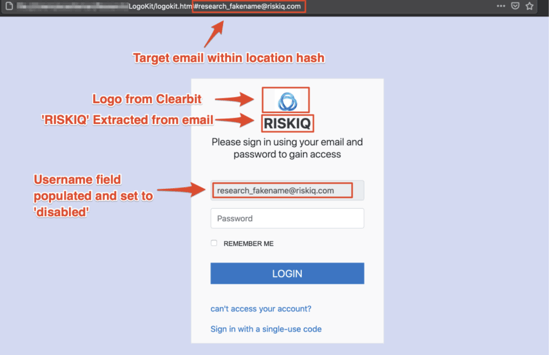
A cybercriminal gang has recently developed a new phishing kit named LogoKit on several domains. LogoKit changes logos and text in real-time in order to adapt to the targeted victims.

This vicious phishing kit has already been released in the dark web according to threat intelligence firm RiskIQ. The firm has tracked it’s progression and in one week the kit was identified in 300 domains, and over 700 within the month.

“Once a victim navigates to the URL, LogoKit fetches the company logo from a third-party service, such as Clearbit or Google’s favicon database,” said RiskIQ security researcher Adam Castleman in a report this week.

The firm also shared a screenshot of how this malicious kit works:

Risk IQ Example Phishing Kit

Source: Risk IQ

This kit can be very tricky to identify from standard phishing templates because most need perfect pixels that mimic the company’s authentication page. RiskIQ is still actively tracking the kit and fear that the kit’s simplicity could significantly improve the chances of a successful phishing attack.

Make sure your organization is frequently being tested with the latest attacks. New-school security awareness training can ensure your users know how to spot and report any suspicious activity in their day-to-day operations.

READ MORE

Trickbot is Targeting the Legal Sector

Researchers at Menlo Security warn of an ongoing Trickbot campaign targeting the legal and insurance industries. Trickbot is a notorious remote access Trojan that was in the crosshairs of separate operations by US Cyber Command and Microsoft late last year. While these operations crippled the malware’s botnet ahead of the US elections, they weren’t expected to deal the malware permanent damage. Menlo Security says this new campaign is a sign that Trickbot’s operators are back on their feet.

“This ongoing campaign that we identified exclusively targeted legal and insurance verticals in North America,” the researchers write. “The initial vector appears to be an email, which includes a link to a URL. While in the past Trickbot has used weaponized documents, the infection mechanism detailed in this campaign seems to be a new modus operandi used by this group.”

The attackers are using emails with a link to a phishing page that informs the user that they’ve committed a traffic violation (“negligent driving” in the example shared by the researchers). The page has a button for the user to “Download PHOTO PROOF,” and instructs the user to download their documentation. Clicking this button will download a zip archive that will result in the installation of Trickbot. Menlo Security notes that, “At the time of writing this blog, some of the URLs identified in this campaign have very little to no detection on [VirusTotal].”

“Where there’s a will, there’s a way,” the researchers conclude. “That proverb certainly holds true for the bad actors behind trickbot’s operations. While Microsoft and it’s partners’ actions were commendable and trickbot activity has come down to a trickle, the threat actors seem to be motivated enough to restore operations and cash in on the current threat environment.”

You may think that the crook’s screamer “PHOTO PROOF” would tip anyone off, sadly, it can work, especially on the unfamiliar. New-school security awareness training can help your employees recognize both familiar and novel forms of social engineering.

READ MORE

Beware the Long Con Phish

Social engineering and phishing happen when a con artist communicates a fraudulent message pretending to be a person or organization which a potential victim might trust in order to get the victim to reveal private information (e.g. a password or document) or perform another desired action (e.g. run a Trojan Horse malware program) that is against the victim’s or their organization’s best interest. Most are quick flights of fancy. One email, one rogue URL link, one phone call. The fraudster is counting on the victim’s immediate response as key to the success of the phishing campaign. The longer the potential victim takes to respond the less likely they are to fall for the criminal scheme.

But there is another version of social engineering and phishing that relies on a longer length of time and requires multiple actions by the victim to be successful. There are many sophisticated hackers who intentionally spend weeks or months building up rapport with a potential victim, creating a trusted relationship over time that is eventually taken advantage of. These long-term cons can often be more devastating to the interests of the victim. Everyone needs to be aware of these types of phishing events, because, although they are far rarer, they do happen. Awareness is the key to fighting them. Let’s take a closer look at how they come to be, examples of long-term con scams and what we can do to better protect ourselves, our teams and our organizations.

Pretexting

The common description of these longer-term cons often involves pretexting, which is the act of creating an invented scenario in order to persuade a targeted victim to release information or perform some action. Pretexting can also be used to impersonate people in certain jobs or roles, such as technical support or law enforcement, to obtain information. It usually takes some back-and-forth dialogue either through email, text or the phone. It is focused on acquiring information directly from the actions taken by the targets, who are usually in high-risk departments such as HR or Finance.

In long-term con scams, scammers don’t hurry the pretexting. A social engineer may call a potential victim, say someone in accounts payable, and introduce themselves as their new contact point for such-and-such company, who the accounts payable person regularly pays invoices to. But instead of asking that the accounts payable person to immediately pay a new invoice to a new bank as most business email compromise scams do (which would rightly raise considerable suspicion) the phisher will casually bring up the person’s name that the accounts payable person previously dealt with give a plausible reason they have moved on, such as a promotion.

After establishing themselves as the new contact, they will lay the groundwork for changes that might happen in the future. For example, might give a sob story such as, “And our new boss is bringing in a new accounting system at the same time, so we’re all having to learn new tasks and a new system at the same time. Can you believe that? Like my job isn’t hard enough. And I hear he’s also thinking about switching to a new bank with better interest rates that he used to use at his previous job. I swear every new boss ends up bringing the system from their last job and its up to us to learn everything new. But for now, nothing changes. Just keep paying the invoice to the same place you always have been. I’ll send you the updated information when we get it. Thanks for your patience.” And just like that the hacker establishes a foothold of trust by not asking for any immediate transaction or change to occur, thereby removing initial suspicions, and starting the beginnings of a new relationship.

Compromising IT Security Researchers

The risk of the long-term phishing scam came rushing back with the reports of the latest story, where a very sophisticated campaign by North Korea was launched against multiple security researchers. The scammers created fake identities, Twitter profiles, YouTube videos, and research blogs. They not only posted their own “original” research (which turned out to be fake or rehashes of other expert’s discoveries), but were successful in getting other real people to write new articles for their blogs and Twitter accounts. All the information and postings were re-amplified through the other fake identities and blogs, along with real, unsuspecting researchers, adding the sphere of legitimacy to the fraudulent identities and content.

After gaining the trust of respected security researchers the fraudsters would send them Trojan Horse-poisoned Microsoft Visual Studio Project files as part of a supposed vulnerability collaboration effort. The victimized security researchers would then unknowingly install Trojan Horse code that compromised their own devices, organizations, and information. Other times, simply visiting the fake researcher’s blog appears to have installed malware on the legitimate researcher’s fully patched computers. The attackers then could access and see what the legitimate researchers were working on. This is pretty incredible access as many researchers are often aware of dozens to hundreds of unannounced vulnerabilities. An attacker learning about these unannounced vulnerabilities could, at the very least, become aware when their own real-life attacks were starting to be noticed. A more dangerous scenario is that they could use the “0-days” against any organization with the involved software.

You can read more about this fascinating, true-life scenario. This blog article recounts the maliciousness in more detail and lists the Twitter and blog links involved. There is more information in this article as well by the Register.

The North Korean long-term con is obviously a nation-state attack, as was their widely successful attack against Sony Pictures in 2014. The 2014 attack woke up every company to worrying about nation-state level attacks. Before that attack, most companies only worried about sophisticated, well-resourced, attacks by nation-states if they were in the national defense game. Once Sony Pictures’ emails were outed, every company realized they could be successfully targeted by a nation-state without realizing they had incidentally offended some other country. It was a wakeup call. This campaign targeting security researchers is another.

Pretty Good Privacy Scam

The security researcher example is startling, but it is not new. I remember back in the 1990’s when a computer security reporter decided to prove that security researchers could be scammed, especially if they relied upon Pretty Good Privacy (PGP) digital keys to establish trust. Back then, PGP was considered to be a gold standard of privacy and identification. Anyone could create a PGP public/private key pair and then use the recipient’s public key to send encrypted messages. The recipient would send their PGP key to the sender as needed, or could be stored on distributed, public, PGP key servers, to be downloaded at-will when needed. Unlike the Public Key Infrastructure (PKI) model, PGP doesn’t have an inherent third party to verify the identity of the user before signing the user’s keys (creating a digital certificate). The best PGP could do is to have other PGP-users attest to and verify that a participating sender was who they said they were by using their (unverified or verified) PGP keys to sign the other person’s keys. It was sort of like an SAT math prep question: If A trust B and B trusts C then A can trust C. The issue here was that few people involved in the key verification process really went out of their way to verify anyone or any key.

To reveal that the whole digital key trust mechanism of PGP was flawed and built upon weak and unverified assumptions, the security reporter created a fake identity, that of a beautiful female security researcher. There were not too many of those back in the day, so “her” presence was sure to attract a lot of attention. This female persona created PGP keys and began to correspond with dozens of internationally-recognized security researchers, including names you would still recognize as authorities today. “She” gained the trust of many of those researchers over time by simply participating in online conversations and appearing interested in their research. Over time, she was referred by one respected researcher to other respected researchers and “her” PGP key was signed and/or verified by trusted researchers to one another.

In the end the reporter revealed the scam and fake persona and shared that he had been able to gain access to many otherwise secret security research data and reports. It was similar to the North Korean scam, but with PGP keys instead of Twitter and YouTube (which did not yet exist). The reporter’s revelation blew the doors off the “security” of PGP keys and revealed that security researchers could be just as easily fooled by digital Mata Hari’s as their real-world counterparts. Turns out flattery (and the hint of sexual innuendo in some instances) works as well to allay suspicions now as it did in the 1990’s or during World War I. A big part these spying scams is their long-term play. The slower and longer a scammer plays the game the more likely they are to gain real trust. Time appears to be a big advantage to phishers when the scam is done right.

Scams Can Involve Real Companies

Surely one of the biggest and most financially-damaging phishing scams was that of a single person who successfully phished more than $120M from the likes of Facebook and Google over a three-year period. The scammer, Evaldas Rimasauskas, was able to successful convince very sophisticated and knowledgeable accounts payable clerks and executives that he was the new contact point for their ongoing personal computer buys. To that end he opened up real, incorporated companies with identical names to the real, spoofed companies (incorporated in different countries) and created look-a-like domain names.

Rimasauskas was eventually arrested, ironically due to his advanced paper trail, and sentenced to 5 years in prison. It was another example of an audacious scam conducted over several years, which fooled the most advanced and prepared targets. I remember thinking at the time of his arrest and identification, “If Google and Facebook can be scammed, what hope do the rest of us have?” Turns out all we need is awareness of these types of scams, training, and polices.

Defenses

Awareness of these types of threats is the first defense. The best thing you can do to avoid these scams is to make sure any employee with access to sensitive information (financial data, research, etc.) knows and understands these types of scams.. Share this article and others like it. People must be aware that not all phishing scams are singular emails asking for an immediate action to happen. That’s step one.

Step two is to make people aware that email, texting, and phone calls are not definitive authentication. A phone call or text can come from anywhere. Even if the sender or caller is not spoofing the phone number (or short number) involved, unless the phone number is previously known to the receiver, how can the receiver know who is really calling or texting? They can’t. Everyone needs to understand that anything other than a face-to-face meeting or voice call from a familiar voice and/or phone number that has a long history of trust, must be treated skeptically from the very beginning, especially if they are in a position where finances or research is involved.

Educate employees that the person calling them claiming to be from the company’s bank may not be from the bank. The SMS text claiming to be from Google security may not really be Google security. A blog claiming to be from a respected security researcher may not be from a respected security researcher even if other people who you trust are vouching for them. “Hey, you can trust them because I trust them!” is a claim that has been proven wrong against hundreds of thousands of victims over the centuries.

US President Ronald Reagan is credited with first publicly using a well-known Russian proverb, “Trust, but verify.” That’s good advice for anyone involved in any transaction. If someone calls up claiming to be your new contact point out of the blue, reach out to the former contact person to verify. If the new person claims the former person has been laid off, call the former contact person’s boss. If an email arrives from a person you trust from their regular email address that you recognize, but they are claiming you are supposed to send money to a new bank, call that person on their previously documented phone number and verify. If someone calls you claiming to be from Microsoft and that they have discovered viruses on your computer, ask them if you can call the very public, well-known, on-the-Internet, Microsoft tech support number and get transferred to them. If they say no, hang up.

Create education to teach about long-term con phishing attempts and scams and how to defend against them – trust, but verify. You cannot trust anyone on a phone, text message or email to be who they are claiming without additional verification. Teach everyone to have a healthy level of skepticism about any new interaction that could potential compromise their device, network, or organization.

The vast majority of your security awareness training needs to be directed at educating people about the more common, popular types of phishing scams that we see everyday. But don’t forget to discuss the potential damage from long-term phishing scams every now and then during the year, especially with the types of people most likely to be targeted (e.g. accounts payable, HR, finance, senior management, researchers, etc.). You must make people in positions of great responsibility aware of these longer-term ploys.

Additionally, create policies that decrease the potential success of these long-term scams. For instance, create a policy that requires voice confirmation from a previously known resource at a previously documented phone number for any payment information changes. Go farther by mandating that email alone cannot be used for verification. This will make it less likely these types of scams will be to be successful. If you have researchers, create policies which require independent verification for any sharing of research and require that all newly installed software be inspected for malware.

I’m not going to kid you by saying that long-term phishing scams are easy to recognize or defeat. They are, by their very nature, tougher to recognize and beat than the single link or email scams. They are intended to be. But by creating and enforcing policies and security awareness training directed against such scams, you can decrease the risk that they are successful.

Really, the old Russian proverb needs to be more complete. It really should be: Educate, Trust, but Verify.

READ MORE

Microsoft Continues to Dominate as the Leading Brand Impersonated in Phishing Attacks

New data from Check Point Research highlights the latest details on which brands are impersonated, giving insight into where the bad guys are most successful.

Phishing scammers always need to establish credibility to make certain their social engineering tactics work. One of the ways we’ve continually seen phishing attacks establish their legitimacy is through brand impersonation. According to the latest data from Check Point Research’s Brand Phishing Report – Q4 2020, Microsoft was impersonated in 43% of all brand phishing attempts globally. This is a huge jump for Microsoft, as they only represented 3% of such attacks back in Q1 of 2020, according to Check Point Research.The jump is likely due to the massive shift to the cloud, with organizations jumping to Office 365 due to the pandemic.

Brand impersonation is one of the most impactful ways a scammer can trick victims into providing their online credentials. If it reads, sounds, and looks like Microsoft (or any other brand), the potential victim often just decides it is without scrutinizing any specifics that would indicate otherwise.

Among the rest of the top 10 impersonated brands (in order) are DHL, LinkedIn, Amazon, Rakuten, Ikea, Google, Paypal, Chase, and Yahoo.

While the impersonated brands look like they impact individuals and not corporate users, keep in mind that a phishing email doesn’t need to necessarily impersonate Microsoft to imply that the user will need to authenticate to their Office 365 account to “see” the important shipping message or the banking update, etc.

Organizations need to educate their users on the dangers of brand impersonation through Security Awareness Training, where simple checks like reviewing the sending email address to ensure it matches the brand perfectly can easily help fend off corporate phishing attacks.

READ MORE